
A machine needs a part. A project needs a component. A procurement team needs a new vendor. A production line needs a replacement. A contractor needs additional capacity.
Then someone starts searching.
They check Google. They look at supplier websites. They ask a colleague. They open a LinkedIn profile. They compare technical capabilities. They send an enquiry to two or three companies.
And then the buying process continues.
This is why industrial B2B marketing cannot depend on one advertisement, one website visit or one sales call.
Industrial buyers often need repeated exposure before a supplier becomes familiar enough to consider seriously.
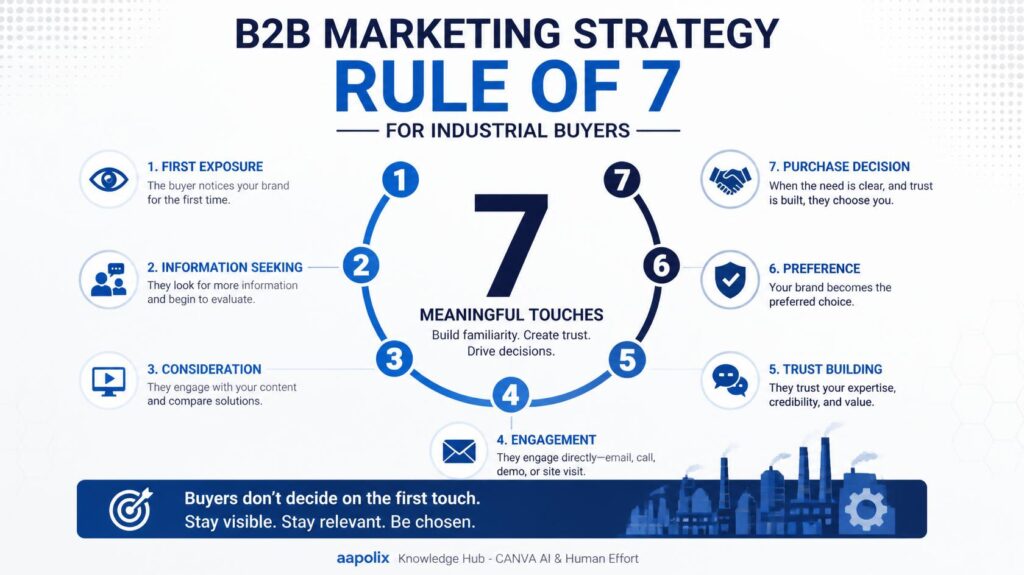
This is where the Rule of 7 can be as a marketing framework.
What Is the Rule of 7?
The Rule of 7 is a traditional marketing idea that suggests a prospect may need to encounter a brand multiple times before taking action. It should not be treated as a fixed scientific number. There is no rule saying that every industrial buyer must see a company exactly seven times before making an enquiry.
The useful idea behind the framework is simpler: One interaction is rarely enough for a complex B2B purchase.
This becomes even more important when the product or service has a high value, technical specifications, long approval cycles or multiple decision-makers.
Why Industrial Buying Cycles Are Different
Consider a company looking for a new laser cutting supplier. The procurement manager may first search for laser cutting companies in Bangalore. Finding a supplier is only the beginning.
The buyer may then check:
- Machine capacity
- Material capability
- Maximum sheet size
- Thickness range
- Production capacity
- Quality systems
- Delivery capability
- Location
- Past work
- Response time
- Commercial terms
There may also be engineers, production managers, procurement teams, finance teams and business owners involved in the final decision. That means the buyer needs more than a company name. They need reasons to continue considering the company.
Seven Touchpoints Should Not Mean Seven Advertisements
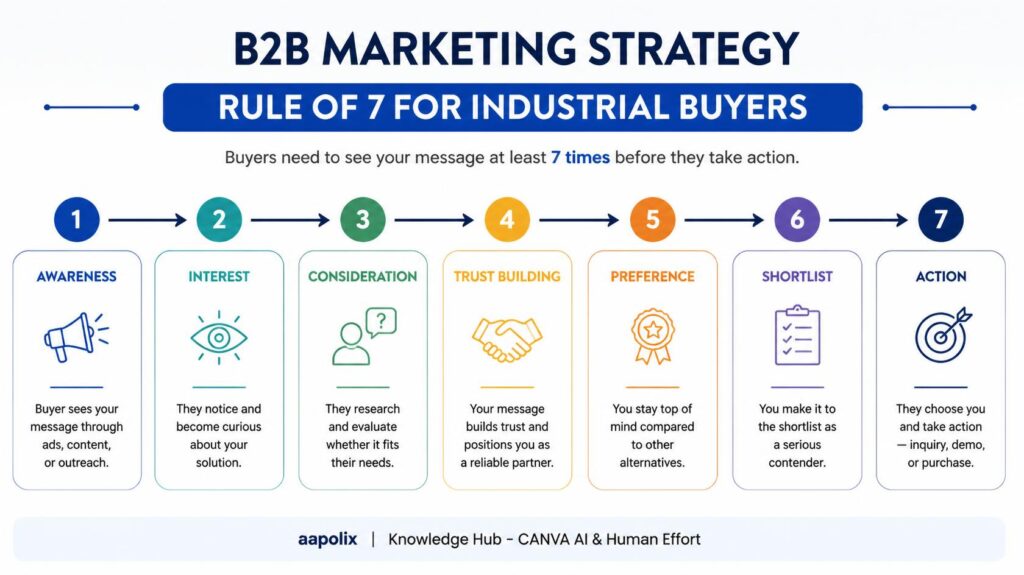
This is one of the most important points when applying the Rule of 7 to industrial marketing. Repeated exposure does not mean showing the same advertisement seven times. It means giving the buyer useful reasons to remember the company at different stages of the buying journey.
For example, the same manufacturing company could appear through:
- A Google search result
- A useful technical service page
- A fabrication capability article
- A LinkedIn post showing completed work
- A case study
- A quotation or technical discussion
- A follow-up from the sales team
These are different interactions. Together, they can make the supplier easier to remember and easier to evaluate.
Touchpoint 1: Be Found When the Requirement Appears
The first interaction often starts with a search.
A buyer may search for:
- Laser cutting services in Bangalore
- Sheet metal fabrication company
- Powder coating services near Bommasandra
- CNC tube cutting supplier
- Industrial fabrication company
- Metal bending services for OEMs
This is where search visibility matters. The company does not need to rank for every possible keyword. It needs to become visible for the searches that match its actual capabilities and customers. A strong industrial SEO strategy therefore starts with understanding what procurement teams, engineers and business owners actually search for when they have a requirement.
Touchpoint 2: Explain the Capability Clearly
Getting the visitor to the website is only the first step.
The next question is:
Can the buyer understand what you actually do?
A service page should answer practical questions quickly. For example, a laser cutting page can explain the materials handled, thickness range, machine capability, application areas and type of customers served.
Instead of simply saying:
“We provide high-quality laser cutting solutions.”
The page should help the buyer understand whether the supplier can handle the actual requirement. Industrial marketing works better when technical information is easy to find.
Touchpoint 3: Show Evidence
A buyer may understand your capability and still ask: Have you done this kind of work before?
This is where evidence becomes important.
Useful evidence can include:
- Project examples
- Case studies
- Machine photographs
- Finished component photographs
- Material examples
- Industry applications
- Customer use cases
- Quality and process information
A simple project story can be more useful than a long list of marketing claims. Explain the requirement, the problem, the process and the result.
Touchpoint 4: Stay Visible During the Research Stage
Industrial buyers do not always enquire after the first visit. They may continue researching for days or weeks. This is where content becomes useful. A manufacturing company can publish practical content around questions its buyers already have.
For example:
- How to choose a laser cutting supplier
- How material thickness affects fabrication cost
- What procurement teams should check before outsourcing fabrication
- How to prepare drawings for fabrication
- When to outsource sheet metal fabrication
This content does not need to be written like a textbook. It should help the buyer make a real business or technical decision.
Touchpoint 5: Build Familiarity Through Social Channels
LinkedIn can play a useful role in industrial marketing because many B2B decision-makers use professional networks to follow companies, people and industry information. But industrial social media does not need to become a daily advertising board. A better approach is to show what the business actually does.
For example:
- A new machine installation
- A completed fabrication job
- A production challenge
- A quality inspection process
- A before-and-after component
- A technical explanation
- A new manufacturing capability
When a buyer sees the company again after discovering it through search, the second interaction feels familiar rather than completely new.
Touchpoint 6: Make the Sales Interaction Useful
Eventually, the buyer may contact the company. This is where marketing and sales need to work together. A buyer asking for a quotation may not simply want a price.
They may also need help confirming:
- Material suitability
- Production feasibility
- Lead time
- Quantity requirements
- Technical specifications
- Finishing options
- Delivery requirements
A useful sales interaction becomes another trust-building touchpoint. The objective is not simply to send a quotation. It is to help the buyer move closer to a decision.
Touchpoint 7: Follow Up With a Reason
Industrial follow-up is often where opportunities are lost. A salesperson sends a quotation. Then nothing happens.
A week later, someone sends:
“Dear Sir, kindly update.”
That is not really a useful touchpoint. A better follow-up gives the buyer a reason to respond.
For example:
- Confirm whether the specification needs clarification
- Ask whether the proposed delivery date works
- Share an alternative material option
- Clarify a quotation assumption
- Ask whether the requirement is still active
Good follow-up continues the buying conversation.
The Rule of 7 Across an Industrial Buying Journey
The seven touchpoints can be mapped to the buying journey.
Search → Website → Evidence → Content → Social → Sales → Follow-up
But the journey is not always linear.
- A buyer may see a LinkedIn post first.
- Then search the company on Google.
- Then read a service page.
- Then visit the website again two weeks later.
- Then contact the sales team.
This is why B2B marketing should be treated as a connected system rather than a collection of unrelated activities.
Do Different Buyers Need Different Touchpoints?
Yes.
- A procurement manager may care about capacity, commercial terms, delivery and supplier reliability.
- An engineer may care more about technical capability, materials, tolerances and drawings.
- A production manager may care about lead time, consistency and capacity.
- A business owner may care about total cost, reliability and long-term supply.
- The marketing message does not need to become completely different for each person.
But the content should answer the questions that each person is likely to ask.
Why Repetition Alone Does Not Work
Seeing the same company repeatedly does not automatically create trust. If every interaction says the same thing, the buyer gains very little new information. Effective repetition adds context.
- The first interaction may introduce the company.
- The second may explain the capability.
- The third may show evidence.
- The fourth may answer a technical question.
- The fifth may explain a customer problem.
- The sixth may provide a quotation.
- The seventh may help the buyer make a decision.
The goal is not seven impressions. The goal is repeated useful information.
Build a Touchpoint Map for Your Business
An industrial company can create a simple touchpoint map without a large marketing team. Start with one important service. For example, sheet metal fabrication.
Then map:
- Search: What does the buyer search for?
- Landing page: What does the buyer need to understand?
- Proof: What evidence can we show?
- Content: What questions can we answer?
- Social: What work can we show regularly?
- Sales: What information does the buyer need?
- Follow-up: What should happen next?
Now the company has a basic B2B marketing system.
Connect Marketing With Lead Management
Repeated marketing exposure becomes more useful when the business can understand what happens after an enquiry.
For example:
SEO → Website → Enquiry → CRM → Qualification → Technical Discussion → Quotation → Follow-up
Without lead tracking, the marketing team may know that website traffic increased but not know whether those visitors became useful business opportunities.
With a simple CRM process, the company can track where enquiries came from, what they required, who owns the opportunity and what happened next. This connects marketing with sales instead of keeping them as separate activities.
Measure the Quality of the Touchpoints
The Rule of 7 should not become a target where the marketing team simply counts how many times a buyer saw the brand.
Instead, measure useful business signals.
- Organic search visibility
- Relevant website visits
- Service page engagement
- Enquiry volume
- Qualified enquiries
- Quotation requests
- Sales opportunities
- Quotation conversion
- Repeat enquiries
- Customer acquisition source
These numbers help answer a better question: Are our marketing touchpoints helping the right buyers move forward?
Do Not Chase Seven Touchpoints at Any Cost
Some industrial buying journeys may involve two interactions. Others may involve twenty. The length depends on the product, order value, risk, technical complexity, supplier qualification process and number of decision-makers.
That is why the Rule of 7 should be used as a framework for thinking about repeated exposure, not as a fixed marketing formula. The important principle is that buyers need enough useful information and familiarity to evaluate a supplier with confidence.
How Aapolix Applies This to B2B Growth
At Aapolix, the same logic can be viewed through three connected areas.
REACH helps the business become visible through SEO, content, social media and branding.
CONNECT helps turn attention into enquiries through landing pages, CRM, funnels and follow-up workflows.
MANAGE helps the business organise the internal process so leads, customers and operational work do not get lost between teams.
The Rule of 7 fits naturally into this model. The buyer may discover the company through REACH, interact with the business through CONNECT and experience the operational side through MANAGE.
The objective is not to force the buyer through seven marketing messages. It is to make every important interaction useful.
Conclusion
Industrial buyers rarely make important supplier decisions from a single advertisement. They search, compare, ask questions, review capabilities, check evidence and speak with suppliers. That is why repeated exposure matters. The Rule of 7 provides a simple way to think about this behavior.
But the number seven is not the main point. The real lesson is to build multiple useful touchpoints across the industrial buying journey.
- Be visible when the requirement appears.
- Explain the capability clearly.
- Show evidence.
- Answer technical questions.
- Stay useful during the research stage.
- Make sales conversations helpful.
- Follow up with a reason.
When these interactions work together, B2B marketing becomes more than generating traffic. It becomes a system for helping the right industrial buyer move from “Who are they?” to “Can they handle our requirement?” and eventually to a real business conversation.
Frequently Asked Questions
What is the Rule of 7 in B2B marketing?
The Rule of 7 is a traditional marketing framework suggesting that buyers may need repeated exposure to a brand before taking action. It should not be treated as a fixed scientific number. For industrial B2B marketing, the useful idea is that one interaction is rarely enough for a complex buying decision.
Does the Rule of 7 apply to industrial B2B marketing?
It can be useful as a framework for planning repeated buyer interactions. Industrial purchases often involve research, technical evaluation, procurement and multiple decision-makers, so buyers may interact with a supplier several times before making a decision.
What are examples of B2B marketing touchpoints for manufacturers?
Examples include Google search results, service pages, technical articles, case studies, LinkedIn content, project examples, sales conversations, quotations and useful follow-ups. The important point is that each touchpoint should provide useful information rather than simply repeat the same advertisement.
Why do industrial buyers need multiple marketing touchpoints?
Industrial purchases can involve technical specifications, supplier evaluation, commercial discussions, delivery requirements and several decision-makers. Multiple useful touchpoints give buyers more opportunities to understand the supplier’s capability and evaluate whether the company fits their requirement.
Should B2B companies try to create exactly seven marketing touchpoints?
No. Seven should be treated as a way to think about repeated exposure, not as a fixed target. Some buying journeys may involve fewer interactions, while complex industrial purchases may involve many more. The focus should be on creating useful interactions throughout the buying process.
How can manufacturers use the Rule of 7 with SEO?
A manufacturer can use SEO to create multiple entry points for buyers by publishing service pages, capability pages, technical articles, application pages and case studies around relevant industrial searches. This helps the company remain visible as buyers research different parts of their requirement.
How can CRM support repeated B2B marketing touchpoints?
A CRM can help track enquiries, customer information, sales stages, quotations, follow-ups and communication. This gives the sales team better visibility into what has already happened and what action should happen next.
How should industrial companies measure B2B marketing touchpoints?
Useful measures include relevant website traffic, search visibility, qualified enquiries, quotation requests, sales opportunities, quotation conversion, repeat enquiries and the source of new customers. These measures are more useful than simply counting how many times a buyer saw an advertisement.